LinkedIn Ads · B2B Pipeline Strategy
How to Use LinkedIn Ads to Turn Existing Website Traffic Into Better B2B Pipeline
A practical way to use LinkedIn Ads when Google Ads is already driving traffic, but pipeline quality is still unclear.
⏱ 10 min read
🎯 CEOs & VPs of Marketing
That distinction matters when a company is already investing in Google Ads, driving traffic to the website, and still trying to understand whether that activity is turning into real sales opportunities.
In that situation, LinkedIn Ads should not simply be treated as another lead generation channel. It should become the layer that helps qualify demand, warm up the buying committee, and turn existing interest into better pipeline.
In this guide
- The problem with asking LinkedIn Ads to “just generate more leads”
- Why existing Google Ads traffic changes the strategy
- Why I would start with middle-of-funnel first
- The mistake: asking cold audiences to convert too early
- Use LinkedIn Ads to warm the buying committee
- How I would structure the campaign architecture
- Stop sending everyone to the same offer
- Measure pipeline quality, not just leads
- A simple framework for combining Google Ads and LinkedIn Ads
- The real lesson
Section 01
The Problem With Asking LinkedIn Ads to “Just Generate More Leads”
I recently worked through a LinkedIn Ads strategy for a B2B company in this exact situation. The company had active Google Ads campaigns, consistent website traffic, and a leadership team that wanted LinkedIn Ads to focus almost entirely on lead generation.
On the surface, that sounds reasonable.
More leads usually sounds like the fastest path to more pipeline.
But in B2B, especially when the sales cycle is longer and the buying committee includes multiple stakeholders, pushing every audience straight into a demo or consultation offer can create misleading results.
That is where the strategy needed to change.
Section 02
Why Existing Google Ads Traffic Changes the Strategy
If a company already has Google Ads running, there is usually an important asset sitting inside the account: existing demand.
People are already searching. People are already clicking. People are already visiting the website. Some of them may already know the brand. Some of them may already be comparing options. Some of them may not be ready to convert yet, but they are no longer completely cold.
That changes how LinkedIn Ads should be used.
Instead of treating LinkedIn as just another lead generation channel, I would use it as a demand qualification and trust-building layer.
Not more leads at any cost. Better demand. Better context. Better conversations. Better pipeline.
Section 03
Why I Would Start With Middle-of-Funnel First
In this case, the existing warm audience size was meaningful, roughly in the 3,000 to 7,000 range.
That matters because LinkedIn Ads retargeting only works when there is enough audience volume to retarget. When the pool is too small, delivery becomes difficult, costs rise, and the campaign can struggle to produce stable learnings.
But when the company already has a viable warm audience, starting with middle-of-funnel can be the smarter move.
The middle of the funnel is where you work with people who have shown some level of interest, but have not yet taken the next step.
- Website visitors
- LinkedIn page visitors
- Ad engagers
- Video viewers
- Lead form openers
- Content downloaders
- Visitors to key product or solution pages
Section 04
The Strategic Mistake: Asking Cold Audiences to Convert Too Early
A common problem in B2B LinkedIn Ads accounts is over-concentration in conversion campaigns and lead gen tactics.
The issue is not that Lead Gen Forms are bad. They can work very well.
The problem is using them too early, with audiences that are still cold, lightly engaged, or not yet familiar enough with the company.
That is one of the most dangerous places for a B2B marketing team to be because the numbers can create the illusion of progress.
- CTR looks fine.
- CPL looks acceptable.
- Forms are coming in.
- The dashboard has activity.
But sales may still be saying: these leads are not ready, these companies are not a fit, these people are not decision-makers, or this is not turning into pipeline.
Section 05
Use LinkedIn Ads to Warm the Buying Committee
In B2B, the buyer is rarely one person.
The decision may involve the CEO, CFO, VP of Marketing, VP of Operations, HR, IT, Procurement, or functional leaders depending on the product.
That is why LinkedIn Ads is so powerful in B2B. It allows you to reach specific companies and then narrow by professional attributes like function, seniority, and role.
For CEOs and VPs of Marketing, this is the strategic shift:
Did the right accounts see the message? Did the right roles engage? Did more than one person from the account interact? Did engagement increase after retargeting? Did sales get better context for outreach? Did the account move closer to pipeline?
That is the real value of LinkedIn Ads in a B2B demand system.
Section 06
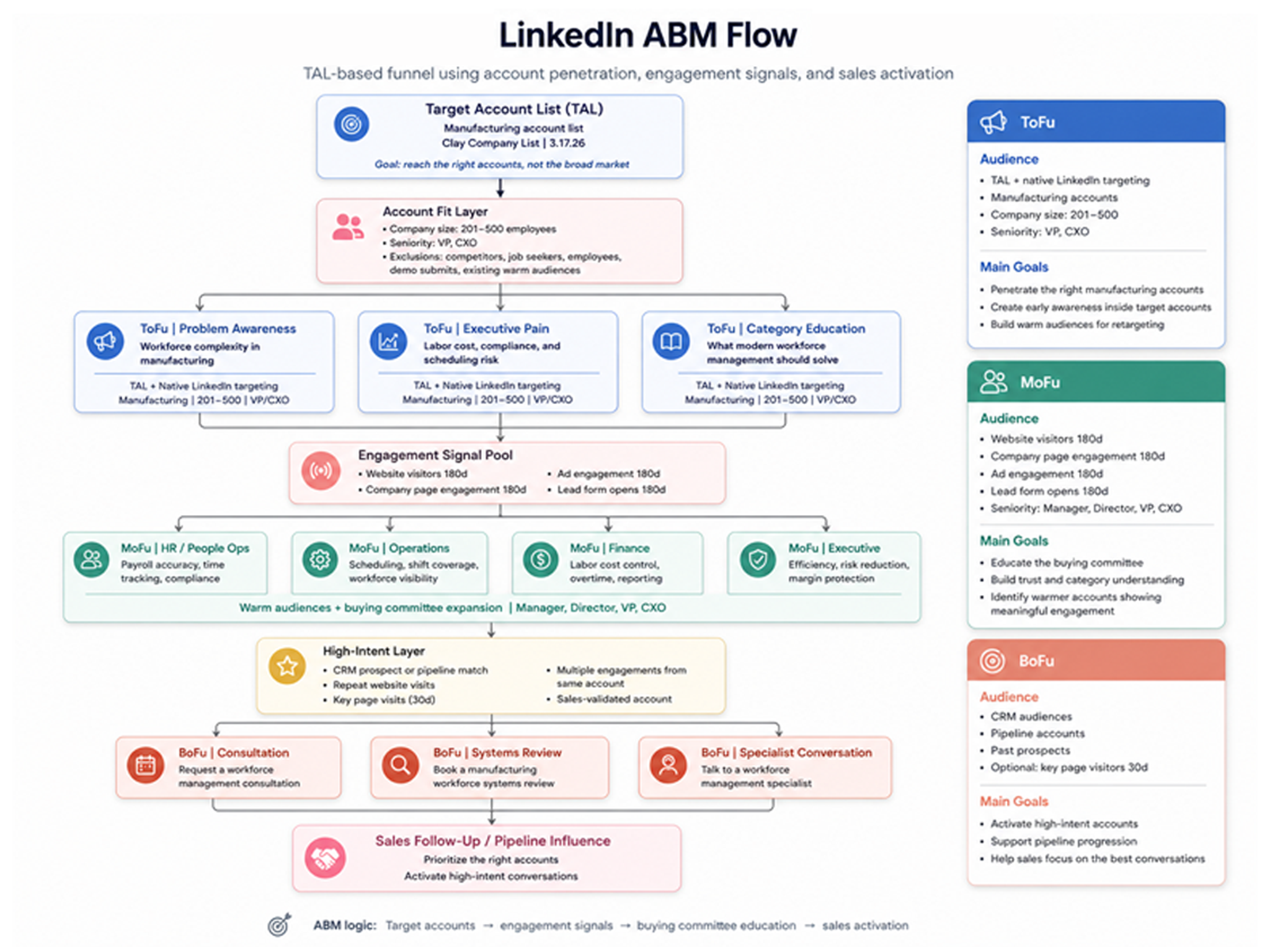
How I Would Structure the Campaign Architecture
For this type of company, I would not start by rebuilding everything at once. I would sequence the work.
1. Stabilize the Middle of the Funnel
The first priority would be to build a clean middle-of-funnel layer from existing demand.
This would include website visitors, LinkedIn company page visitors, ad engagers, video viewers, lead form openers, and people who visited product, solution, or comparison pages.
The goal is not to immediately push all of them to “Book a Demo.” The goal is to educate and qualify.
2. Separate Warm and High-Intent Audiences
Not all retargeting audiences should receive the same message.
Someone who visited the homepage once is not the same as someone who visited a pricing page, opened a lead form, downloaded a guide, and returned to the site within 30 days.
The campaign structure should separate warm audiences, high-intent audiences, CRM audiences, pipeline accounts, past prospects, existing customers, bad-fit audiences, competitor employees, and job seekers.
3. Rebuild Top-of-Funnel After the Warm Layers Are Clean
Top-of-funnel still matters. But in this case, I would not start there.
If Google Ads is already driving traffic and warm audiences exist, the fastest path to improving pipeline quality is usually to work from existing interest first.
Then, once MOFU and BOFU are clean, I would rebuild TOFU with more discipline: clear ICP, tighter account lists, segmentation by company size, seniority and function filters, exclusions, and clear separation by funnel stage.
Section 07
The Role of Content: Stop Sending Everyone to the Same Offer
One of the biggest mistakes in B2B paid media is assuming every audience needs the same CTA.
Cold audiences do not need the same message as warm visitors. A VP of Marketing does not need the same proof as a CFO. A CEO does not evaluate the problem the same way as an operations leader.
For a middle-of-funnel strategy, the content should build confidence.
- Industry-specific case studies
- Problem-focused guides
- Product overview pages
- Customer support differentiators
- Comparison content
- ROI education
- Short videos from leadership or subject matter experts
- Thought leadership posts that reframe the problem
Section 08
The Measurement Shift: From Leads to Pipeline Quality
This is the biggest shift.
Traditional demand generation often asks: how many leads did we get, what was the CPL, and what was the conversion rate?
Those are not useless questions. But they are incomplete.
In a B2B strategy with ABM influence, the better questions are different.
- How many target accounts are engaging?
- Which accounts are showing repeat activity?
- Which roles inside the buying committee are engaging?
- Which campaigns are influencing pipeline?
- Which leads are accepted by sales?
- Which accounts are moving from awareness to consideration?
- Which opportunities came from accounts exposed to LinkedIn Ads?
Section 09
A Simple Framework for Using LinkedIn Ads With Existing Google Ads Traffic
Step 1: Audit Existing Demand
Look at Google Ads traffic, organic traffic, paid social traffic, and website behavior. Identify which pages people visit, which pages suggest buying intent, which audiences are large enough for retargeting, and which channels are driving traffic but not converting.
Step 2: Build MOFU First
Create campaigns for warm website and LinkedIn audiences. Use educational, proof-based, and problem-aware content. Do not overuse hard demo CTAs here.
Step 3: Create BOFU From High-Intent Signals
Use stronger CTAs only for audiences with real intent: 30-day key page visitors, lead form openers, asset downloaders, CRM prospects, pipeline accounts, and repeat visitors.
Step 4: Rebuild TOFU With Account Discipline
Use a Target Account List where possible. Segment by company size, industry, seniority, and buying committee logic. Avoid broad audience expansion. Keep prospecting clean so the data is interpretable.
Step 5: Report on Pipeline Quality
Report beyond LinkedIn Ads metrics. Include accounts reached, accounts engaged, warm audience growth, lead quality, sales accepted leads, pipeline created, pipeline influenced, and cost per qualified opportunity.
FAQ
Common Questions About LinkedIn Ads, Google Ads, and B2B Pipeline
Should LinkedIn Ads be used for lead generation in B2B?
Yes, but not always as the first move. In B2B, LinkedIn Ads usually performs better when lead generation is supported by education, retargeting, and buying committee engagement. If the audience is cold, asking for a demo too early can create low-quality leads.
When should a company start with LinkedIn Ads retargeting?
A company should consider starting with LinkedIn Ads retargeting when it already has meaningful website traffic, LinkedIn page engagement, or CRM audiences. If Google Ads is already driving traffic, LinkedIn can help warm and qualify that demand before pushing for a sales conversation.
How do Google Ads and LinkedIn Ads work together in B2B?
Google Ads captures active demand from people searching for a solution. LinkedIn Ads helps continue the conversation by educating buyers, retargeting website visitors, reaching the buying committee, and improving trust before sales outreach.
What should B2B companies measure beyond leads?
B2B companies should measure sales accepted leads, pipeline created, pipeline influenced, account engagement, buying committee engagement, opportunity quality, deal velocity, and revenue from target accounts.
Why is middle-of-funnel important in LinkedIn Ads?
Middle-of-funnel is where companies educate people who already showed interest but are not ready to convert. This stage helps improve lead quality, build trust, and move accounts closer to a real sales conversation.
The Real Lesson
The client wanted leads. That made sense.
But the better strategic answer was not simply “let’s generate more leads.” The better answer was: let’s improve the system that turns interest into pipeline.
When a company already has Google Ads traffic, LinkedIn Ads should not always start with cold prospecting or direct lead generation. Sometimes the smartest move is to start in the middle.
Retarget the people who already showed interest. Educate them. Build trust. Separate warm from high-intent. Give sales better signals. Then rebuild top-of-funnel with more clarity.
That is how LinkedIn Ads becomes more than a paid social channel. It becomes a pipeline quality engine.
Not more leads. Better opportunities. Better conversations. Better revenue outcomes.